
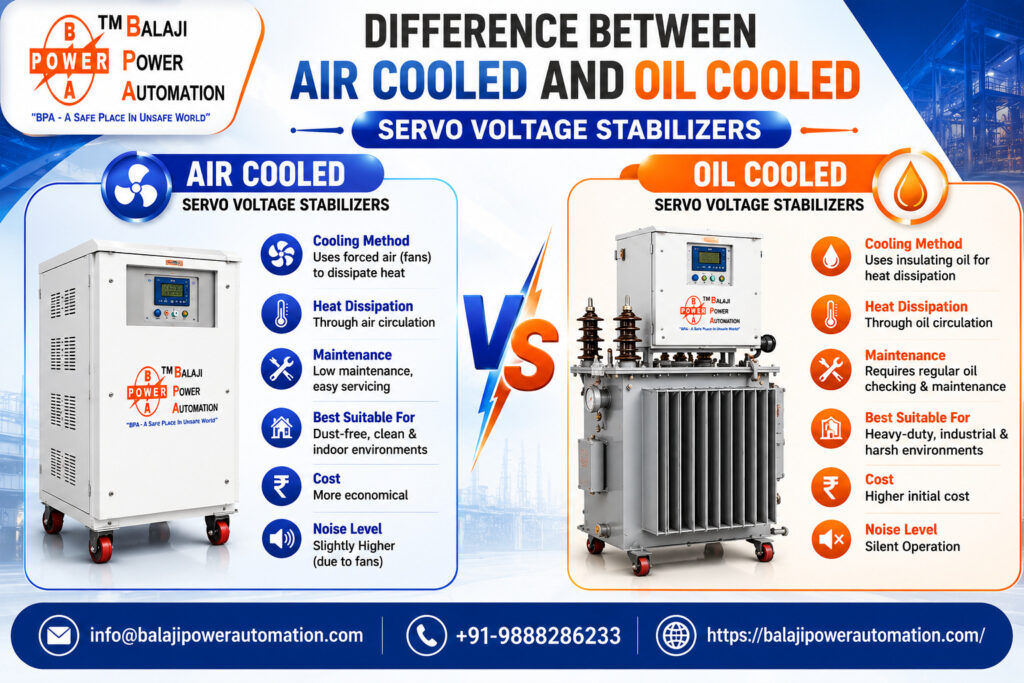
Servo voltage stabilizers are one of the most essential pieces of power conditioning equipment used in modern electrical systems. In industrial and commercial settings, there are many devices, machines, and appliances that rely on a stable and clean power supply. Although the power supply is designed for distribution, the complexity of the electrical system can lead to voltage fluctuations. Addressing these fluctuations for every load is not practical or efficient. A servo stabilizer efficiently corrects these voltage deviations during power flow. Servo voltage stabilizer manufacturers offer two main types: air-cooled and oil-cooled. These types vary in how they manage heat, which affects their suitability for different applications.
Understanding Both Types of Cooling Methods
Oil cooling and air cooling are the two primary cooling methods used by voltage stabilizer manufacturers. Both oil-cooled and air-cooled have the same working principle. They both have a carbon roller that moves the variac transformer to adjust the voltage upon receiving the signal of deviation. However, there are key differences between the two types.
Air Cooled Servo Stabilizer
In this type, the stabilizer uses fans for air circulation and ventilation to dissipate the heat generated during voltage monitoring and regulation. Natural air or forced air can be used for circulation, depending on the specific application needs. These are compact in design and used in moderate power capacity. Commonly used in homes, offices, retail outlets, laboratories, and small to medium commercial establishments.
Oil-Cooled Servo Stabilizer
An oil-cooled servo voltage stabilizer uses an insulating oil to cool the transformer and its components within the system. The transformer is immersed in this oil to remain cool as well as insulated. Used in factories, industrial plants, hospitals, data centers, heavy machinery operations, and large commercial facilities requiring continuous high-capacity voltage regulation.
How To Choose From The Two
The best choice of servo voltage stabilizer manufacturers depends on the load requirements, the operating environment, and specific application needs. Here are some guidelines to help you decide:
Choose Air Cooled Type When:
- The load capacity is moderate.
- The installation space is limited.
- Heat generation is not excessive.
- Maintenance requirements are minimal.
- You need an economical stabilizer.
Go For Oil Cooled Stabilizer When:
- The load capacity is high, including large motors and heavy-duty HVAC systems.
- The equipment runs for long, continuous hours.
- Efficient heat dissipation is required.
- The ambient temperature is high.
Conclusion
A servo stabilizer operates continuously and naturally generates heat, similar to any electrical system that runs for extended periods. To ensure reliable performance, voltage stabilizer manufacturers incorporate a cooling mechanism. Air-cooled stabilizers use either natural or forced air circulation to cool the internal components, whereas oil-cooled stabilizers use transformer oil for cooling. We at Bajaj Power Automation manufacture ISO-compliant servo stabilizers that meet the requirements of modern electrical systems. Our stabilizers are available in a wide range of variants from 30 to 1000 kVA power ratings.