
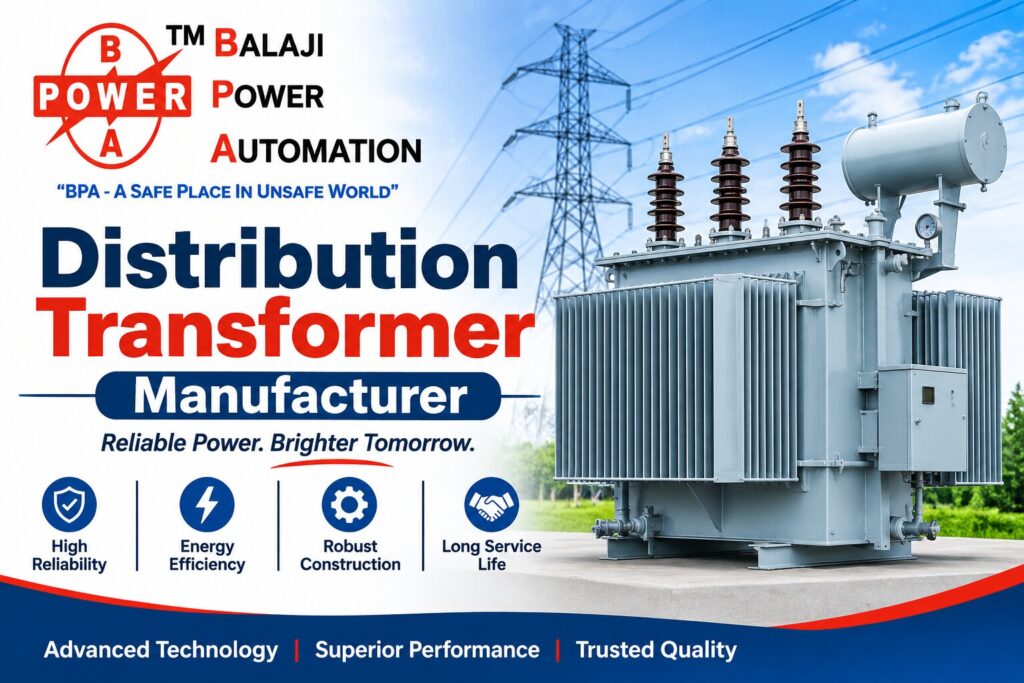
One may overlook the transformers installed near their residential society or commercial complex on the utility poles or concrete foundations. But as soon as the electricity goes off in an unusual pattern, the utility companies suddenly begin to turn to the one who manufactured it. The true differences between the distribution transformer manufacturers show up years after they are installed. They may have similar kVA and voltage ratings, but the difference goes deeper than these surface-level similarities. How they manage the maintenance after sales, material choice, testing reports and warranty terms are some of the key differences. This guide presents the important steps that transformer buyers follow to make their choice like an expert.
Components of Distribution Transformer
Buyers understand that although a transformer is a singular unit, it is a complex assembly of many components. These are the common components used:
- CRGO laminated steel cores are highly reliable for minimizing losses when windings transfer the magnetic flux.
- Copper or aluminium windings are used for carrying current. What matters is their insulation, winding arrangement and cross-section.
- Proper insulation between different electrically charged components prevents faults.
- Transformer processes generate a lot of heat. To cool it down, a ventilation system or oil as a cooling medium is used.
- Rating plate, lugs, oil level indicator, earthing terminals, top filter valve and many more are the standard fittings for completing the assembly.
Choosing The Distribution Transformer
Following these key points helps in choosing the right one among distribution transformer manufacturers:
Match the Power Rating
The consumption pattern, maximum demand, load diversity and other factors in load analysis are evaluated and the right power rating is calculated. The chosen transformer should have a power rating above this calculation to accommodate peak demand changes and insulation degradation over time.
Check the Standards
Inquire from the manufacturer which IS follows the proposed transformer. The specifications applied to utilize the transformer may differ depending on the application and the design of the device, such as IS 1180 or any other IS specifications.
Customization Scope
The transformer installation requirements may be different for various types of installations depending on whether it will be used in medium voltage distribution, industrial installation, or for commercial installation. The requirements of the customer may include a certain primary or secondary voltage, impedance, vector group, tapping scheme, or enclosure.
Support and Warranty
Buying a transformer involves a long-term service relationship. Ask who will be responsible for giving technical assistance, supervising the maintenance of the transformer, providing spare parts, and dealing with warranty claims. Make sure to get the details about the warranty and what is excluded from it.
Watch Out For These Warning Signs
- The supplier is reluctant to show the test document reports or raw material sourcing.
- They show the standard compliance reports, but they are outdated.
- Unclear insulation class or dielectric strength standards.
- High no-load or on-load losses.
- Vague warranties on the winding, core and failure.
Distribution Transformer By Balaji Power Automation
We at Balaji Power take pride in being reliable suppliers of distribution transformers. The power capacity we have is up to 2500 kVA and 33 kV voltage class on the HV side and 11 kV on the LV side. We provide them in pole-mounted, grounded, free-breathing, hermetically sealed, indoor and outdoor type configurations. The reason we stand out is the vast scope of customizations we offer. Our distribution transformers are built under the specifications of IS 2026, IS 1180 and IEC 60076 standards.
Conclusion
A distribution transformer has many internal parts that perform distinct functions, and each of them contributes to the overall unit. The aim is to minimize the losses, maintain efficiency of transformation, and ensure a long life of the transformer. Consultation with an expert engineer or technician is important for accurate selection when looking for distribution transformer manufacturers.
Get in touch with Balaji Power Automation and get the reliable solution.